














Empowering Women, Powering Change: The S4S Technologies Journey with Shell Foundation
Introduction
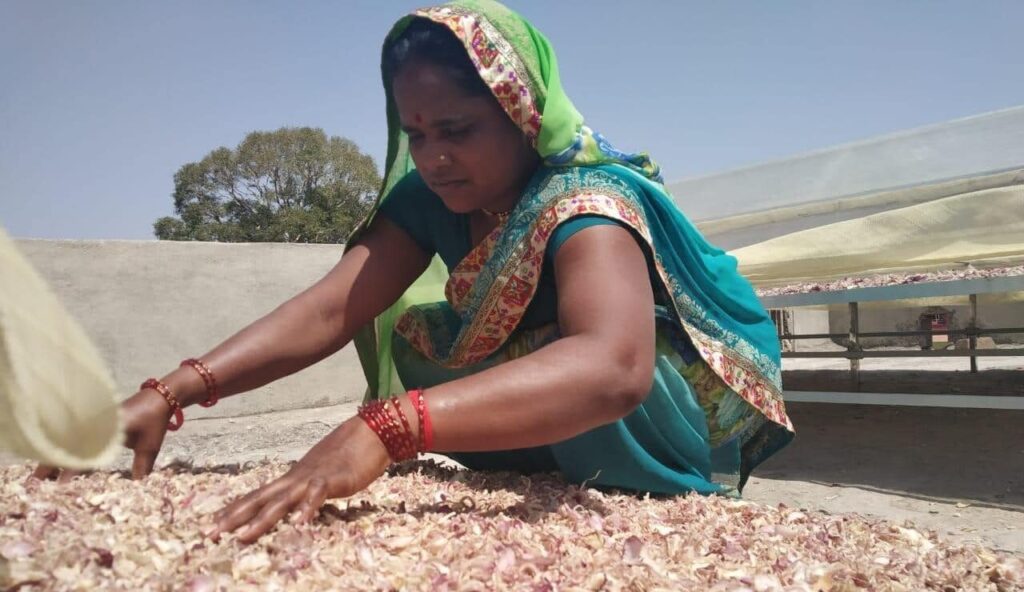
S4S Technologies is an Indian agri-tech enterprise that was established to empower smallholder farmers – especially women through solar-powered dryers and decentralised food processing solutions. Its mission is to reduce post-harvest losses, enhance farmer incomes, and strengthen climate resilience by enabling women-led micro-enterprises. It has a current network of 100,000 smallholder farmers supplying their crops to 1400 women micro-entrepreneurs.
The company’s award-winning electricity-free Solar Conduction Dryer (SCD) can dehydrate produce and extend shelf life by up to one year without chemicals or preservatives. Through its model, S4S Technologies sells solar dryers to rural women micro-entrepreneurs who purchase rejected or lower grade produce from smallholder farmers, process it using the dryers, and sell dehydrated products back to S4S Technologies. These are then aggregated, packaged, and sold to large-scale food producers and service providers.
This circular, energy-efficient model reduces waste, improves farmer earnings, and ensures stable incomes for women micro-entrepreneurs. By embedding training, quality control, and guaranteed off take, S4S Technologies built a scalable, low-risk ecosystem that links smallholders, women micro-entrepreneurs, and large food markets.
The journey of S4S Technologies and its partnership with Shell Foundation (SF) and FCDO’s Catalysing Agriculture by Scaling Energy Ecosystems (CASEE) programme demonstrates how catalytic support and entrepreneurial innovation can together unlock transformative, gender-intentional pathways to scale.
Phase 1
Building the Blueprint: From Idea to Impact (2011-2017)
S4S Technologies began in 2011 with the development of its patented Solar Conduction Dryer (SCD) – an affordable, off-grid dehydration solution for fruits, vegetables, grains, and spices. The technology aimed to reduce the high levels of post-harvest loss among smallholder farmers.
Commercial sales began in 2014, with over 2,700 units sold in more than 15 countries. However, the team soon realised that the smallholder farmers they sought to serve could not afford the dryers and lacked access to viable markets for dehydrated products. This insight prompted a major pivot: S4S Technologies would not only sell dryers but also facilitate access to markets – transforming itself into an integrated food value chain enterprise.
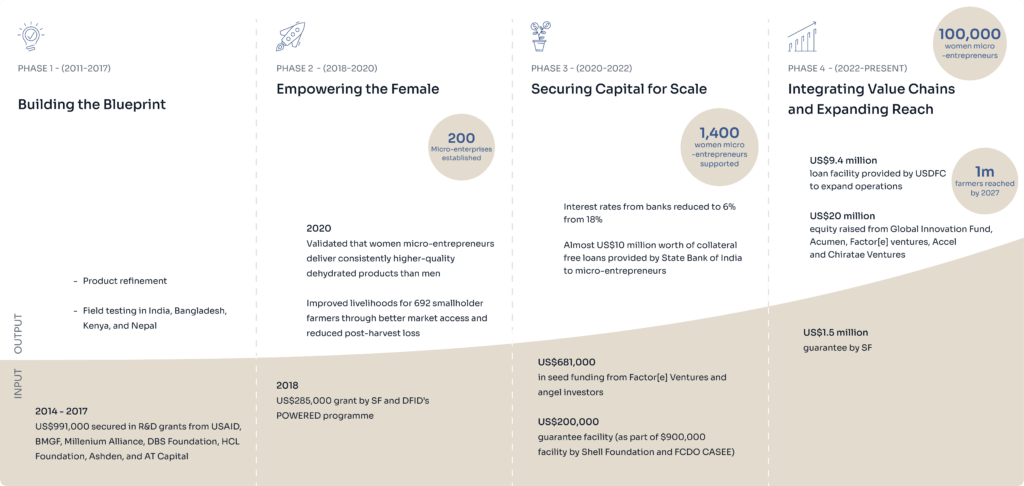
To improve the SCD’s design and test its applicability across contexts, S4S Technologies secured US$991,000 in R&D grants from USAID, BMGF, Millennium Alliance, DBS Foundation, HCL Foundation, Ashden, and AT Capital. These funds supported product refinement, field testing in India, Bangladesh, Kenya, and Nepal, and nutrition impact studies among women smallholders.
Phase 2
Empowering the Female Micro-entrepreneur (2018-2020)
The company’s next challenge was to find a viable, inclusive business model. S4S Technologies recognised that women micro-entrepreneurs could operate the dryers more effectively than smallholder farmers themselves, given their proximity to produce and their reliability as operators.
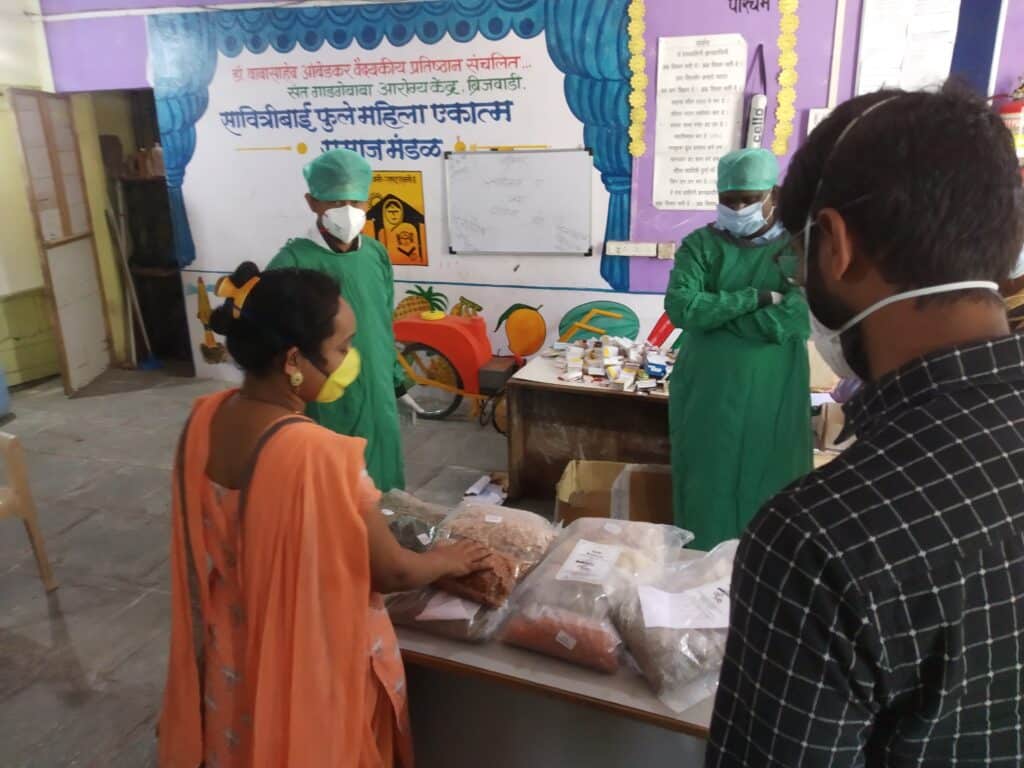
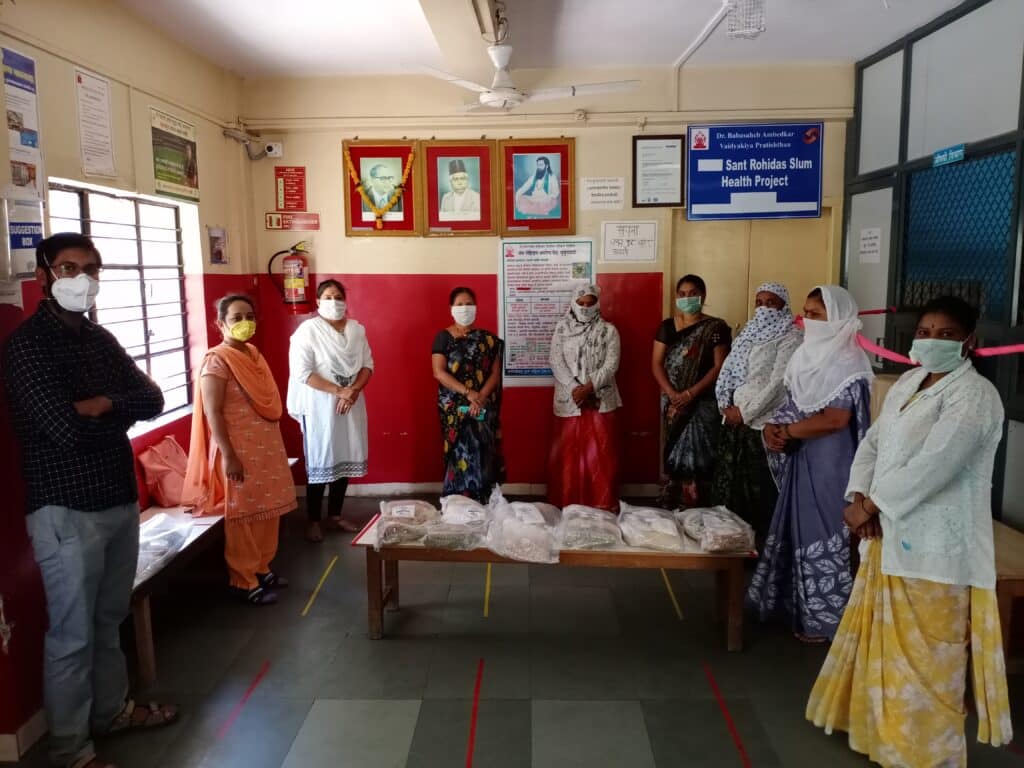
In 2018, with a US$285,000 grant from Shell Foundation and DFID India’s POWERED programme, S4S Technologies piloted a rental-based model – leasing dryers to rural micro-entrepreneurs and training them in usage and quality control. The results were striking – while men produced higher volumes, women consistently delivered superior quality aligned with market standards.
This insight led S4S Technologies to focus exclusively on women micro-entrepreneurs (MEs) as its core producers. By standardising operations across multiple villages, the enterprise created 200 micro-enterprises and improved livelihoods for 692 farmers. The pilot also enabled the establishment of a central processing hub and formal B2B partnerships with corporates such as Capital Foods – a leading Indian packaged food company that offers ready-to-eat snacks.
Phase 3
Securing Capital for Scale (2020-2022)
Encouraged by early success, S4S Technologies sought to refine its model for scale. However, the asset-heavy rental approach – where S4S Technologies owned the dryers and purchased produce – required substantial capital, limiting expansion. Scaling meant acquiring more dryers and financing larger volumes of produce, posing a sustainability challenge.
To address this, S4S Technologies secured US$681,000 in seed funding from Factor[e] Ventures and angel investors, alongside debt financing from Yunus Social Business, Samunnati, and Jai Kisan. These funds supported product improvements, network growth, and working capital needs.
Still, high-cost financing remained a barrier for the women micro-entrepreneurs, who faced borrowing rates of 18–31% from micro-finance and non-bank lenders. To de-risk lending, S4S Technologies received a US$200,000 loan guarantee facility from Shell Foundation (SF) and FCDO’s CASEE programme to raise capital from Maharashtra Grameen Bank. This enabled 300 women micro-entrepreneurs to access credit at just 6% interest, with zero defaults – a milestone that attracted larger institutions like the State Bank of India, which subsequently lent over US$10 million to women entrepreneurs without collateral.
This breakthrough proved that women borrowers were bankable, inspiring confidence among mainstream financial institutions and establishing a replicable blended finance model for inclusive growth. To date, Maharashtra Grameen Bank has been able to provide credit to 1400 micro-entrepreneurs
Phase 4
Integrating Value Chains and Expanding Reach (2022-Present)
As S4S Technologies grew, it confronted challenges in sourcing raw materials and ensuring resilience. Initially dependent on intermediaries, it realized that empowering women micro-entrepreneurs as local aggregators would improve supply reliability and farmer linkages.
S4S Technologies thus transitioned to a women-led aggregation model, sourcing directly from smallholder farmers and creating decentralised production hubs. In parallel, it began vertical integration – expanding into value-added products such as ginger oil and raisins. This enhanced margins, diversified risk, and strengthened resilience against climate variability.
With growing market traction, S4S Technologies raised US$1.75 million in Pre-Series A funding from Acumen Fund and Factor[e] Ventures to optimise technology and expand its women entrepreneur network.
In addition to this, the team realised that to expand its operations into multiple geographies and meet the minimum volume quantity from its corporate buyers, it needed to secure affordable and scalable debt. Support to access this debt to expand operations came in the form of a US$1.5 million guarantee that was provided by the Shell Foundation and the FCDO’s CASEE programme to the United States Development Finance Corporation (USDFC). This guarantee enabled the USDFC to provide a US$9.4million, 10year, unsecured debt facility to S4S Technologies. The funding from the USDFC enabled significant expansion of S4S Technology via investment into new equipment and facilities that increased its ability to procure fresh produce through its Village Level Collection Centres (VLCC) as well as increased value-addition across existing product lines.
Subsequent rounds raised over US$20 million in equity, attracting investors such as Global Innovation Fund, Acumen, Factor[e] Ventures, Accel and Chiratae Ventures.
S4S Technologies is now investing in a US$10 million factory to scale value-added processing and strengthen its export footprint. Its next goal is to reach 100,000 women micro-entrepreneurs and 1 million smallholder farmers within five to six years.
Conclusion
The journey of S4S Technologies underscores a replicable blueprint for scaling clean energy-enabled agribusiness in low-income markets. By addressing systemic barriers across finance, technology, and value chains – and by centering women as economic agents – S4S Technologies has demonstrated how clean energy innovation can simultaneously drive income growth, climate resilience, and gender equity.
The case exemplifies how catalytic partnerships, like that of Shell Foundation, FCDO and S4S Technologies, can enable climate-smart enterprises to move from pilot projects to systems-level transformation while banking on women micro-entrepreneurs as agents of scale.